It's part of being an eccentric Englishman to have pet names for the coins in your pocket. The pound is a quid, a shilling is a bob, and a sixpence is a tanner. Those lovable English speaking colonists with whom I now reside in the USA have continued the tradition with bucks, dimes, and bits.
It's very important to gather this information together over the next decade or two before the people who grew up using "real money" die off and the knowledge is lost forever. There is a great deal of fraudulent information being peddled about OUR local heritage by patronising academics who consider themselves to be experts on the culture of us peasants. These people have never dropped an "h" in their lives, ignore them!
Do non English speaking countries follow in this fine tradition or is it purely an Anglo Saxon thing? Please share.
Here's an article on the subject written by one of the Royal Mint's none too bright quota hires:
I've never heard of a 6d being referred to as a Bender. The writer claims it's because they were made of silver and could be bent. That makes no sense, other coins were made of silver and copper can be bent with just a little more effort.
No Sir, the sixpence was called a tanner. Trust me, I was there! The writer acknowledges this further down the page but once again is embarrassingly wide of the mark, claiming it derives from a Romany word "Tawno". Bollocks! The coin is named after an early coin designer, John S Tanner! Where do the Royal Mint find these people? I'm thinking I should offer to do the job in exchange for a nice Petition Crown or two they have lying around.
Here's a few other explanations which I find credible:
The 3d was named Joey after the MP Joseph Hume who advocated for it's introduction to bridge the small change gap between the penny and the sixpence. The name was applied only to the tiny sliver coins and never to the ghastly brass version which replaced them.
The pound is probably called a quid because of it's use in major transactions. It wasn't used for such trivial things as buying your morning newspaper or to pay your servants for the month. I think it's something to do with the expression "quid pro quo".
The US "buck" is a throwback to the early days on the frontier where barter was far more common that using cash. A buck refers to the value of one deer carcass.
Can anyone offer an explanation of "bob" or a better alternative to any of the above?
A final thought...... Decimalisation of our currency robbed us of a large chunk of English folklore. In the push to convert reluctant Englishmen into mere Europeans our leaders have destroyed much of what made England so uniquely England. That's why I don't collect coins later than 1970.
Non illegitimis carborundum est. Excellent advice for all coins.
Make Numismatics Great Again!
I just remembered last year we had a post similar... I will try to add the link.
In venezuela we had a slang for our demonetized coinage...
5 bolivares = Fuerte
.50 cents = Real
.25 cents = Medio
.12,5 cents = Locha
.5 cents = Pulla or Puya (cannot remember).
The notes were also having names for the 500 and 100 (orquidea and marron).
Canadian coin slang is almost identical to American, except for our $1 and $2 coins (which the Americans don't have). The $1 is famously called a "loonie" (because it has a loon on it) and the $2 is called a "toonie" (because it starts with "two" and rhymes). We call our almost-never-seen $0.50 coin a "fifty-cent piece", while Americans call theirs a "half dollar". And while Americans sometimes call $100 a "Benjamin", I have never in my life heard a Canadian call $100 a "Borden".
Maybe a Quebecois member will have some more interesting slang words from French Canada?
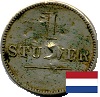
0,05 = stuiver (
0,10=dubbeltje/dubie
0,25= kwartje (we dont have one since 2001 but we still use it)
1,00=piek
2,50=knaak (we dont have since 2001 but we still use it)
There are some others which I never hear; from wikipedia;
for the Dutch speaking people:
Spie (1 centmunt)
Stuiver (5 centmunt)
Dubbeltje (10 centmunt, duppie, beissie): hoe een dubbeltje rollen kan, zo plat als een dubbeltje
Kwartje (25 centmunt, maffie[4], heitje: heitje voor 'n karweitje): begint het kwartje te vallen
Gulden (piek, pegel, pop) (Nederlandse 1 gulden)
Daalder (1½ guldenmunt): op de markt is uw gulden een daalder waard
Rijksdaalder (knaak, riks, achterwiel, karrenwiel) (2½ guldenmunt)
Vijfje (bas, dikke stuiver, fiets) (2 rijksdaalders) (5 guldenmunt of -biljet)
Tientje, (joetje, mattenklopper, prent) (10 guldenbiljet)
Bank biljetten (notes) Geeltje (25 guldenbiljet; de versie van 1861-1909 had een gele kleur)
Zonnebloem, bram, brammetje (50 guldenbiljet)
Meier, mutje, snip, bank(ie)/bankje (100 guldenbiljet)
Vuurtoren (250 guldenbiljet, met een afbeelding van de vuurtoren van Haamstede)
Rooie rug, rooie of rug (1000 guldenbiljet, oorspronkelijk rood- maar later groengekleurd)
A pound comprised twenty Shillings, commonly called 'bob', which was a lovely old slang word. It was 'bob' irrespective of how many shillings there were: no-one ever said 'fifteen bobs' - this would have been said as 'fifteen bob'. The origin of the word 'bob' meaning Shilling is not known for sure, although the usage certainly dates back to the late 1700s. My favourite is suggested in Brewer's 1870 Dictionary of Phrase and Fable in that 'bob' could be derived from 'Bawbee', which was 16-19th century slang for a half-penny, in turn derived from: French 'bas billon', meaning debased copper money (coins were commonly cut to make change); and/or the Laird of Sillabawby, a 16th century mintmaster. Perhaps there is also a connection with the church or bell-ringing since 'bob' meant a set of changes rung on the bells. This would be consistent with one of the possible origins and associations of the root of the word Shilling, (from Proto-Germanic 'skell' meaning to sound or ring). There is perhaps a connection with a plumb-bob; (the association with another heavy piece of metal), made of lead and used to mark a vertical position in certain trades, notably masons. Separately (thanks SH) it is suggested that the 'bob' slang for shilling derives from Robert Walpole, Privy Councillor and 'Paymaster of the Force', who paid the 'King's shilling' to army recruits, although Walpole's early 1700s timing somewhat predates first recoded late 1700s usage of the slang itself.
http://www.facebook.com/NumismaticsUK
I'm not an expert in any kind of coins, but I reckon I'm good at research and will do my best to help. Feel free to tell me my identifications/valuations/gradings are wrong. It's the only way I'll learn.
Russian - some of these date centuries back, some have survived to this day:
1/4 kopeks = polushka
2 kopeks - grosh (up to 19th century; after Poland became part of the Russian Empire, 1 zloty = 15 kopeks and grosh (1/30 zloty) became 1/2 kopek). Other names: semishnik, semitka, dvushka
3 kopeks - altyn, trioshnik
5 kopeks = pyatak/pyatachok
10 kopeks = grivennik
20 kopeks = dvukhgrivennyi/dvukhgrivennik
25 kopeks = chetvertak/polupoltinnik
50 kopeks = poltinnik
1 rubles - tselkovyi
10 rubles = chervonets
Quote: nalaberongBut they don't circulate and they don't have a cute nickname.
They certainly do circulate! But you have to ask for them. In general, shop keepers are eager to get rid of them. I travelled through the West of the USA for three weeks, and obtained almost 20 dollar coins. The only place where they refused to change 'metal for paper', in spite of the fact that they had a whole tray full of them, was near a campsite, where dollar coins were used to operate showers.
Quote: nalaberongBut they don't circulate and they don't have a cute nickname.
They certainly do circulate! But you have to ask for them. In general, shop keepers are eager to get rid of them. I travelled through the West of the USA for three weeks, and obtained almost 20 dollar coins. The only place where they refused to change 'metal for paper', in spite of the fact that they had a whole tray full of them, was near a campsite, where dollar coins were used to operate showers.
You can get them at banks, but even at banks don't have more than a few of them ready, so if you want to get a roll, the teller will usually have to go to the vault to grab them.
I'm inclined towards that old scoundrel Walpole, although bawbee is a contender.
It is strange that neither quid nor bob has a plural. Well at least for everyone except for my wife who insisted on pounds being quids when we lived in England.
Non illegitimis carborundum est. Excellent advice for all coins.
Make Numismatics Great Again!
The name of some pre-decimal coins have survived in language(s) for several centuries:
France: the sol (french: sou) was used until the revolution. Being 'pennyless' you say in french: 'Je n'ai plus un sou'.
The italian equivalent in name 'soldo', pl. 'soldi' is still used in expressions like: 'Gana un sacco di soldi' (he is well paid) 'Non abbiamo piu soldi' (we ran out of money)
In the 18th century Dutch republic, provinces minted their 'stuiver', a tiny silver coin. The stuiver was equivalent to 8 duit (a small copper coin). Both names have survived till the present day in expressions like: 'Zijn duit in het zakje doen' (make a small contribution) 'Hoe een stuivertje rollen kan' (said about a surprising and unlikely coincidence or outcome).
The dutch guilder was worth 20 stuiver and till 2001 (almost two centuries after decimalization), the 5 Cent coin was still called a 'stuiver'.
1 krona - bagare/bagis (baker), though not as common as it used to be.
10 kronor coin - guldpeng (golden coin), because of it's colour.
20 kronor note - Selma (after Selma Lagerlöf who is portrayed on the front).
1000 kronor note - Lakan (sheet), they used to be quite large!
There must have been others as well, but I don't know them.
A couple of nick name for some pre decimal UK coins:
Bob - the common nickname for an English shilling. Dickens used the term in Pickwick Papers. Tanner - A slang name for an English sixpence. Dickens uses the term in Martin Chuzzlewit (xxxvii). Joey - A nickname given to the English silver four pence. Sometimes used for the three pence e.g. threepenny joey
I only know a few terms mostly used by old people for the old Mark currency
Sechser (sixer) for 5 Pfennig Groschen (originally 12 Pfennig) for 10 Pfennig and today 10 Cent
those are remnants of the old duodecimal system
the only real nickname I know of is the Heiermann for 5 D-Mark pieces it's a north german term and could be derived from the word Heuer (hire) that you had to pay to the sailors.
found another Copper noses referring to English silver of the fourth and fifth coinages of Henry VIII. Theses coins were greatly debased and soon began to wear and the inferior metal showed the nose on the kings face in a copper colour.
Quote: GwydeThe name of some pre-decimal coins have survived in language(s) for several centuries:
France: the sol (french: sou) was used until the revolution. Being 'pennyless' you say in french: 'Je n'ai plus un sou'.
Although monetary currency is exclusively the Franc since the French Revolution, with the Cent as centesimal value, the French were using the terminology "sou" till the middle of XXth century
Before the Revolution "Pound" (later Franc) was divided into 20 "Sous" and each "Sou" or "Sol" divided in 12 "Deniers".
So 1 Franc contains 20 "Sous". The theoretical value of "Sou" was 5 Centimes.
The famous holed 5 Centimes was the "sou"
and the 25 Centimes, was well known as the 5 "sous" coin
No, this is not a joke, between 1914 and 1946, more than 700 million coins of 5 cents, about 1.5 billion coins of 10 cents, nearly 250 million 20 cent coins and and over 360 million coins of 25 cents were produced made in Nickel, copper-nickel, nickel silver (maillechort), zinc or iron, they heaviered our wallets for nearly forty years and represent a total weight of nearly 9,000 tons of metal.
These are the most common and popular french currencies.
These "holes in" coins, as they were nicknamed : 1, 2, 4 and 5 "sous" were circulating without problem until the eve of World War II. Containing strategic metal fot the arming, they were demonetized in 1941 and 1942 in favor of the Germans.
An act of passive Duty to the enemy and the occupant was to keep these small coins, regarding their reduced purchasing power, in order not to favor the German armament factories. Therefore, these coins are still very common. They were replaced by "ersatz" zinc which had a much lower life because of the metal. All these coins were demonetized in 1947.
All these coins are common and they are sold by the kilo in poor condition, but the exception proves the rule. The coin of 5 centimes 1914, which was not put into circulation and is therefore a pre-series, now worths nearly 10,000€ , the 10 cents struck only 3972 copies worths more than 20,000€ in XF condition.
So it's always worth looking into iron boxes from Grandpa's attic, and aluminum cases where your grandmothers hidden and forgotten these hidden treasures. Maybe you can find the rare bird, the "hole in" sou leading to the Pactolus
And in the US. The Susan Anthony dollar. Was called Carters quater. They came out when presdent Carter was in office. And the size are very close.
People were getting them mixed up. So the US followed what Canada did. So all US dollars now are know as gold dollars. Everyone hates the Susan B Anthony dollar,But i like them. Get one or two amonth still. Most have about 60 of them
Quote: adithyasraoIn India before 2005, i used to hear many street venders calling 25 paisa as 4 annas and the 50 paisa as 8 annas .
The street vendors got it right: the rupee has been a hexadecimal currency before (probably the only one). Moreover, half and quarter annes have been common. The 1/12 anna existed but was as obsolete as the 1/3 farthing.
Quote: Flukeex pats in Spain before the euro called "peseta's".....Potato's or Spuds (slang for potato)
I just called them Zloty's :-) or actually any currency where you buy a bread with 1000. But nowadays the Zloty is actually a strong currency. The times they are a-changing
... whereas Spaniards used to call the early brass 1 peseta coin "rubia" and 5 pesetas were generally known as 'un duro'. The unit 'duro' was also used for larger denominations: e.g.
25 pesetas = 5 duros. As the 5 pta coins got downsized, the nick changed to the diminutive 'durito'. Less common slang was the nick 'doblón' for the chunky brass 100 pesetas. Historically the doblón was an old Spanish and colonial gold coin.
1) in general in the Gulf as "the fat lady dollar" as it is still known today.
2) In Egypt: "Rial Nimsawi" - the German taller (ooops! - what the heck?? )
3) Around the Red Sea: "Rial Kabir" - the big taller
4) in Yemen: "Qirsh HaDsar" - the strong Piaster
5) in Yemen: "Qirsh Fransi" - the French Piaster (... where did they get this one???"... )
6) in Constaninople: "Qara Qirsh" - the black piaster
7) in Sudan: "Rial-abu- Nukta" - the father of points
8) in Somalia: "Shariq qirsh as-Suez al-fransiyy" - Eastern Piaster of French Suez
9) in Zanzibar. "Januairio" - January (??? - no clue why?)
10) in Suaheli: "Reali Meosi" - black taller
11) in Abessinia: "Rial Abu Tair" - father of birds
12) in Khartoum: "Qirsh Rial Kusheriyy" - Piaster of birds and finally:
13) in Hungary: "A Nagyanya" - the great grandma source: "Gábor Fazekas: Mária Terézia Tallér 1780"
Quote: "pnightingale"Good find Bizzo.
I'm inclined towards that old scoundrel Walpole, although bawbee is a contender.
It is strange that neither quid nor bob has a plural. Well at least for everyone except for my wife who insisted on pounds being quids when we lived in England.
Hi, Just came across this old post, very entertaining. The word bawbee was used a lot when I was young a few years back, usually relating to a small coin not specific, very Scottish term.
"bent as a nine bob note" was also term used often relating to being a little corrupt, as it should be a ten bob note ( ten shilling banknote).
Here's a link to song often heard in Scotland back in the day relating to bawbee https://www.youtube.com/watch?v=fOE4mMcyG68
people talking without speaking, people hearing without listening
The young lady whom cuts my hair had to leave El Salvador or suffer the consequences. She knows my love of "the hobby" and had her parents send me some coins.
The one on the left is called the "mother-in-law". I'm guessing because of the size (?).
It ain't what you don't know that gets you into trouble. It's what you know for sure, that just ain't so. Mark Twain
Quote: "Peter M. Graham"Agreed, very interesting old thread.
The young lady whom cuts my hair had to leave El Salvador or suffer the consequences. She knows my love of "the hobby" and had her parents send me some coins.
The one on the left is called the "mother-in-law". I'm guessing because of the size (?).
1 Colon, The Mother-in -Law, best one yet, best look after her
people talking without speaking, people hearing without listening
Quote: "nalaberong"Canadian coin slang is almost identical to American, except for our $1 and $2 coins (which the Americans don't have).
Of course the US has dollar coins! Right now the US mint is issuing a dollar coin with a different president on it! I have 14 of them.
But they don't circulate and they don't have a cute nickname.
they sure do circulate! I used to work 2 blocks from the US border and ended up collecting about 40 of the US "loonies" just from daily transactions at my store.
Quote: "nalaberong"Canadian coin slang is almost identical to American, except for our $1 and $2 coins (which the Americans don't have). The $1 is famously called a "loonie" (because it has a loon on it) and the $2 is called a "toonie" (because it starts with "two" and rhymes). We call our almost-never-seen $0.50 coin a "fifty-cent piece", while Americans call theirs a "half dollar". And while Americans sometimes call $100 a "Benjamin", I have never in my life heard a Canadian call $100 a "Borden".
Maybe a Quebecois member will have some more interesting slang words from French Canada?
In Quebec many people (including my sister) still say "un trente sous" ("a 30 sous") for the 25¢ coin. Note that they don't say something costs 30 sous, they just call the coin with that name. While this may sound illogical, it goes back to New France (i.e. pre-1760) days, where the livre/pound/dollar was divided into 120 sous... which means that a quarter of a livre was, indeed, 30 sous, i.e. a quarter or 25¢.
The 50¢ coin used to be call an écu, and this too was going back to New France, but I've never heard anyone use it. I suspect it died a quiet death when the 50¢ disappeared from circulation in the 1940s and 1950s.
Quote: "eitan190"In Argentina there is just one that I am aware of:
1 peso= Mango. (Or "un mango")
How that tradition started, I have no idea.
Mango is shared on the River Plate region (so named Uruguay + Buenos Aires province).
Seems it comes from start of 19th. century, when mango was a way to refer to dirty money (stolen, frauds, etc.), as it was earned in an "easy way", now word seems to be shortened from marengo, that also was used for dirty money, and marengo referred to the Marengo battle, that Napoleon won easily. That's the most accepted theory.
On the other hand, there are and were many nicknames for money, at Argentina, they used to call "Fragata" to 5 pesos banknote, cause it had a vessel of this kind on it.
Also 5 cent coins were called "Cinquiño" (little five), and 20 cent were called "Vintén" (20th.), both modified Brazilian words "cinquinho" and "vintém"
1,000 Pesos are called "1 luca", 1,000,000 Pesos are "1 palo", (and dollar money are named as verde -green- USD 1,000= 1 luca verde, USD 1,000,000= 1 palo verde).
At certain time, 10 cent coins were called "real" (nothing related to Real currency from 18th. century), and that would be an average tip, taxi drivers were (and still are) mentioned as "realeros", as they would work for the pits, earning more than their salaries.
Nicest refference I heard was from a homeless begging for money: "Sale un Varela para la uva?" This needs an explanation for several Uruguayan, and more for foreign people. Textual translation would be "goes a Varela for the grape?" Varela is the man shown in the $ 50 banknote, worth about 1.50 USD, grape is a way to refer to the wine, so this would mean "maybe $ 50 for wine?"
Just 10 options: you understand binary, or you don't.
Catalog Referee Coins, Banknotes & Exonumia: Uruguay, Cuba, Bolivia, Brazil, Chile, Colombia, Mexico, Peru, Paraguay, Costa Rica, Venezuela, Panama, Ecuador, Zamunda, Parva Domus and more.
In Sweden we have a lot of names, and most of them makes no sence at all – unless you know the story behind it. When Sweden's banknotes got colours they got names after root vegetables, like "the beetroot" and such.
Common names for the current currency is spänn, pix, and riksdaler (which was the currency prior 1873). You can use these however you want, like "I need 25 spänn for a coke" or "I paid 400 riksdaler for this shirt". Even people in the stores uses riksdaler a lot "that'll be 1,575 riksdaler".
When talking about thousands you can also switch the thousand to either lax (salmon, due to the pink colour of the 1,000 kronor banknote '76-'88), bagis (slang for baker), lök (onion), papp (cardboars), lakan (bed sheet, due to the size of the 1,000 kronor note '52-'73 - same size as an A4 paper).
The 1 krona note from 1874 to 1941 was called kotia (litterally: cow ten). The reason for this is because when people were buying cows at the market, which let's says cost 40 kronor, they used to place a 10 kronor note on top and switch one or two 10's to 1's, since they had the same size and colour. This was equal to switch a 100 US-dollar bill to a 1 US-dollar bill.




 Anthony dollar. Was called Carters quater. They came out when presdent Carter was in office. And the size are very close.


 )
)


