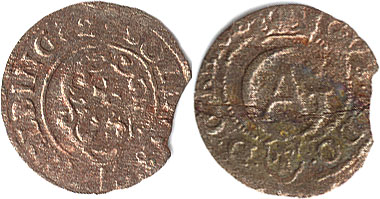
I don't think these are German coins, at least not exactly. After much research over the past day, and much agonizing, here's what I think I know about these coins, and the process it took me to get there:
1. Their denomination is that of the "Solidus", which was a coin that was popular around the Baltic Sea in the 16th through 18th centuries, including in Poland, Sweden, Danzig, Riga, Courland, etc.
2. The monograms of "CR" and "GA" are consistent with some monograms of "Carolus Rex" (Karl IX of Sweden) and "Gustavus Adolphus" (Gustavus II Adolphus of Sweden). The "CR" could also be "Christiana Regina" (Christina of Sweden, Gustavus II Adolphus' successor), but her monograms tend to carry a stylized "T" instead of an "R".
3. The reverse coat of arms flat-out look like the baroque-era coat of arms for the City of Danzig. My only problem with that is that, to my knowledge, Danzig was never occupied as a territory of Sweden, but merely invested by Swedish armies in the 30 Years War.
The coat of arms could be that of Riga, which depicts an "iron cross" above crossed keys, as Riga was an Archbishopric, but its hard to tell if the image here is of two crosses, or one cross and one set of badly worn keys.
What I think is most likely is that this is the coat of arms of Elbing, which depicts one dark cross and one light cross. See the examples here:
http://www.medievalcoinage.com/saurma/someoldcoins.org/saur/g/s347.htm
4. The word "Civi" appears on the reverse of the second coin, followed by what looks like "RIBINS". I've seen several coins from Riga that say "CIVI RI
GINSIS. The most likely answer, again, is that the wording is "CIVI ELBING", meaning the city of Eblag in Old Prussia, now Poland. Elbing was occupied heavily by Sweden in the 30 Years War, and coinage was produced there at that time.
5. Finally, I ran across this image, which appears to be spot on for your second coin:
http://www.rustypennies.com/catalog/pix/ab575.jpg
So, in conclusion, I think your Coin #1 is a Silver Solidus from the reign of Christina of Sweden, likely between 1632 and 1642, although her monogram would be unusually plain if that were the case. I have to say her, because during the reign of Carl IX, Sweden didn't occupy Elbing, whereas Elbing was still a Swedish town into the 1640's. This is most likely your coin, although we can't tell the year because its a mis-strike:
http://www.ngccoin.com/poplookup/WorldCoinPrices.aspx?category=108952&worldcoinid=282107
your Coin #2 is almost certainly this coin, a 1632 Silver Solidus from Elbing:
http://www.ngccoin.com/poplookup/WorldCoinPrices.aspx?category=108949&worldcoinid=282094
I hope that helps. It was a fun process digging for this one, and I think I've got you on the right coins. Approximate values are listed on those links; I'd say Coin #1 is in Good condition or so, and Coin #2 is in VG condition, for its age. I'm not an appraiser or coin valuation expert, so those are just my opinion.