In another thread pnightingale showed off his Penny that was dated 3913
Maybe you also have an "odd" coin in your collection with perhaps an even odder story behind it. If so, please feel free to share it and it's strangely odd story here.
Collector of Third Reich coins (1933 - 1946), and Australian coins.
Not swapping at this time.
I hunk the only real odd coin in my collection is an Isle of Man 50pence piece, which is a recognised mule.
Its KM57a, if you wish to look for it.
It is odd, due to the fact that it does not tells you where it is from. This due to the two dies being used, do not belong together, with each of the other dies, both having ISLE OF MAN on them instead.
I have have not yet come across a coin, with the country name accidentally produced, being on both sides, although, someone out there will tell me there is one.
Are we talking odd as in the actual coin type being weird, or a common type but an example of it with an interesting mark/story on it?
Assuming it's the latter, I have this Philippines 50 Centavos from 1936 that I posted also on the War Coins thread a while back:
The obverse looks fine but the reverse is like that because it spent a few years at the bottom of Manila Bay to avoid being captured by Japanese soldiers in WWII.
I think my oddest coin is a USA five cents coin, dated 1900.
The coin looks like it was buried at some time; it is off center; has a large zigzagged "valley" on the obverse; it looks undersized and thin; and the color does not look right for the type.
I wrote to Alan Herbert (error coin expert) back when he was verifying error coins, and he said it was probably acid treated (I disagreed). I sent it to him, and he returned the coin with this explanation:
A piece of metal was rolled into the planchet, and later fell out after it was struck (this is why the valley has rounded edges); and the coin was struck on a planchet intended for a coin for a Central American or South American country. This was possible because Scovill Manufacturing Company in Waterbury, Connecticut, made planchets for several countries, and for the U. S. Mint, at that time.
A few years later, at a bookstore, I found the 5th edition of Alan Herbert's "Official Price Guide--Minting Varieties and Errors" (1991). On page 180, under "III-B-17 Struck on a Rolled-in Metal Planchet (WE)" was a photo of the obverse of my coin!
Thus, it also became the first of my coins to ever be published!
P.S.--At one of the ANA's Worlds Fairs of Money in Chicago, I attended the awards banquet, and was seated next to Mr. Herbert, so I got to meet him in person. (He has since passed away.)
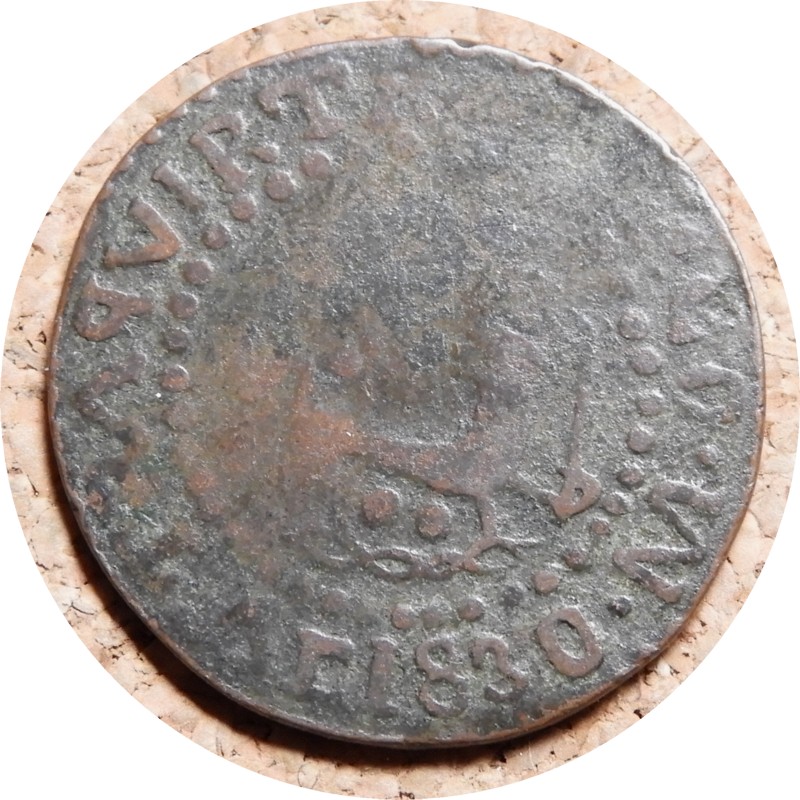
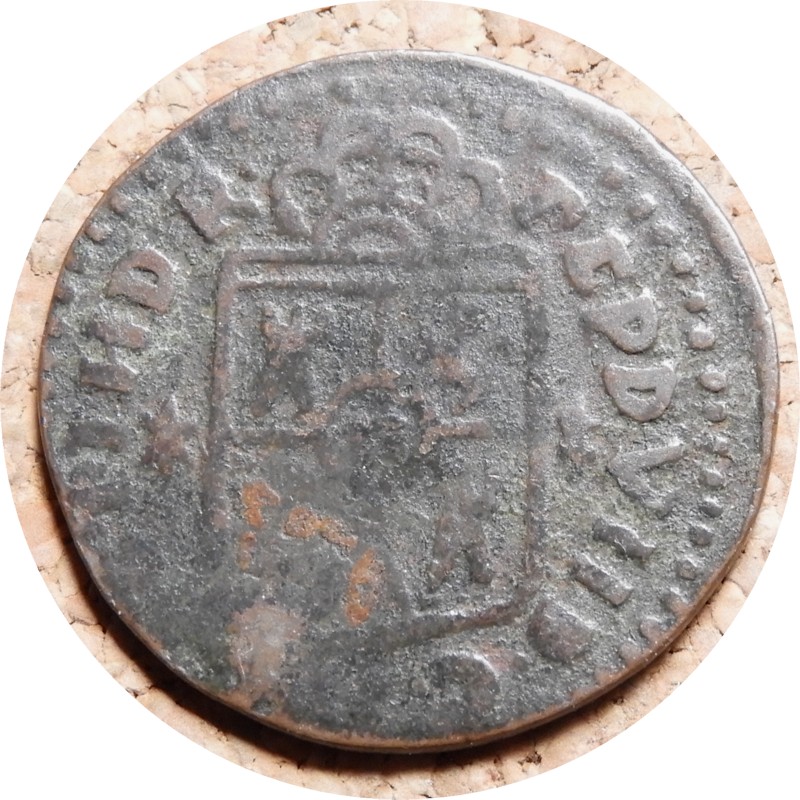
The following coin is guenuine, was minted only two centuries ago... and it's quite well preserved (I know, it's hard to believe !)
The first coins minted in the Philippines were made by chinese contractors and the result was quite awful...
On this one, the lions were badly done, the lettering is barely lisible on the observe and I completely gave up when I tried to read the legend on the observe.
At least, they didn't mess up on the date with that one .
In the same spirit, I got what seems to be a contemporary forgery of a Carlos II dinero :
I had trouble to read the date on it... until I realise the engraver made a mistake when he created the reverse die : the date is readable in mirror on this coin
Do you have a picture of your 5 cents ? I'm curious to see what it look like.