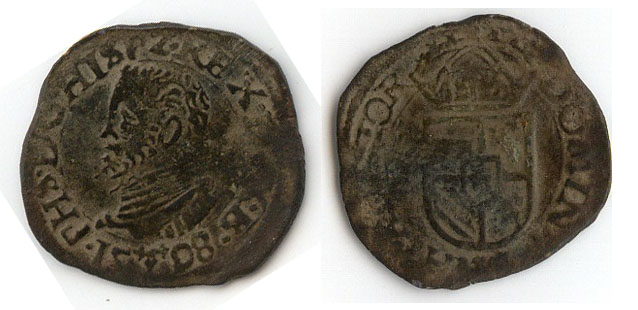
The obverse has bust of Philip 1st facing left. Legend reads "PH & D.G. HIS Z REX DUX B" which I believe is "Philip by the grace of God King of Spain and Duke of Burgundy". The date, 1506 is at 6 o'clock.
The reverse has a crowned shield with coat of arms and the Latin phrase "DOMINUS MIHI ADJUTOR" - Lord give me counsel.
It's 23mm, copper and weighs 1.9 gr.
It was issued by Philip the Handsome, husband and regent of Joanna of Castille (sister to Catherine of Aragon, Mrs Henry Tudor).
What I can't find out is the denomination. There is such a jungle of coinage issued by the various Spanish regions and for use in the recently discovered new world, I don't know where to begin.
Here are some pictures!
Non illegitimis carborundum est. Excellent advice for all coins.
Make Numismatics Great Again!
It is not a Castilian coin. It's from Brabant, mint Maastricht.
Perhaps is a mite or double mite. I'm not sure. The main reference for coins of Dukes of Brabant and Burgundy is the book of Dewitte www.numisbel.be/Dewitte_2.pdf Perhaps you can find your very clean coin there.
Referee for Spain, Iberia (ancient), Suebi Kingdom and Visigothic Kingdom
Quote: zegeriIt is not a Castilian coin. It's from Brabant, mint Maastricht.
Perhaps is a mite or double mite. I'm not sure. The main reference for coins of Dukes of Brabant and Burgundy is the book of Dewitte www.numisbel.be/Dewitte_2.pdf Perhaps you can find your very clean coin there.
Thank you!
I will try a search in that direction. I'm on the right lines with Philip the Handsome though right? He presumably kept the title of Duke of Burgundy after marriage?
This is one of the most interesting parts of coin collecting, identifying obscure coins.
Non illegitimis carborundum est. Excellent advice for all coins.
Make Numismatics Great Again!
Can the date be 15*96? If can, then he is Philip II (Mr. of Mary Tudor) and your coin is exactly the negenmanneke with number Dewitte 861. The star in the date means Maastricht mint.
Quote: zegeriCan the date be 15*96? If can, then he is Philip II (Mr. of Mary Tudor) and your coin is exactly the negenmanneke with number Dewitte 861. The star in the date means Maastricht mint.
What a most popular part of history, you would think that the value of coins would be much higher when associated with such things, where are all the historians who understand the value of old coins?
I have noticed that there are thousands of pounds of "scrap" coins that are so common that no one wants them, however if every boyscout group, school teacher, and history buff got into coins just a little bit, there would not be enough to go around.
Nice coin, how did you score it?
Taking a break from swapping for a while, but still interested in pre 1799 Spanish coins, I will make time for that!
Quote: redsmithstudiosWhat a most popular part of history, you would think that the value of coins would be much higher when associated with such things, where are all the historians who understand the value of old coins?
I have noticed that there are thousands of pounds of "scrap" coins that are so common that no one wants them, however if every boyscout group, school teacher, and history buff got into coins just a little bit, there would not be enough to go around.
Nice coin, how did you score it?
It was part of a collection I bought from the estate of a deceased collector. Well, it would be more accurate to describe him as an accumulator. He had hundreds of coins in ring binders but had made no attempt to form a collection. All coins with holes in them, either intentionally or drilled to make into a necklace, were grouped together, square coins, zinc coins, aluminium coins..... 90% of it was common junk but he had a lot of early coins which were nice.
Non illegitimis carborundum est. Excellent advice for all coins.
Make Numismatics Great Again!
I think another clue on the 1596 bit is the legend "His Z Rex", which stands for "Hispaniae 2 Rex" -- "King of the Two Spains". This is interesting for a number of reasons. No King since the eleventh century had called himself King of Spain until Charles V; additionally, the "Two Spains" refers to Spain and New Spain (Mexico), which wasn't called the Viceroyalty of New Spain until 1521, when the conquest was complete. Definitely Philip II.
Oh, and pnightingale, I owe you a message back. I've been away for a while.


 sorry i can not help, i hope some one can