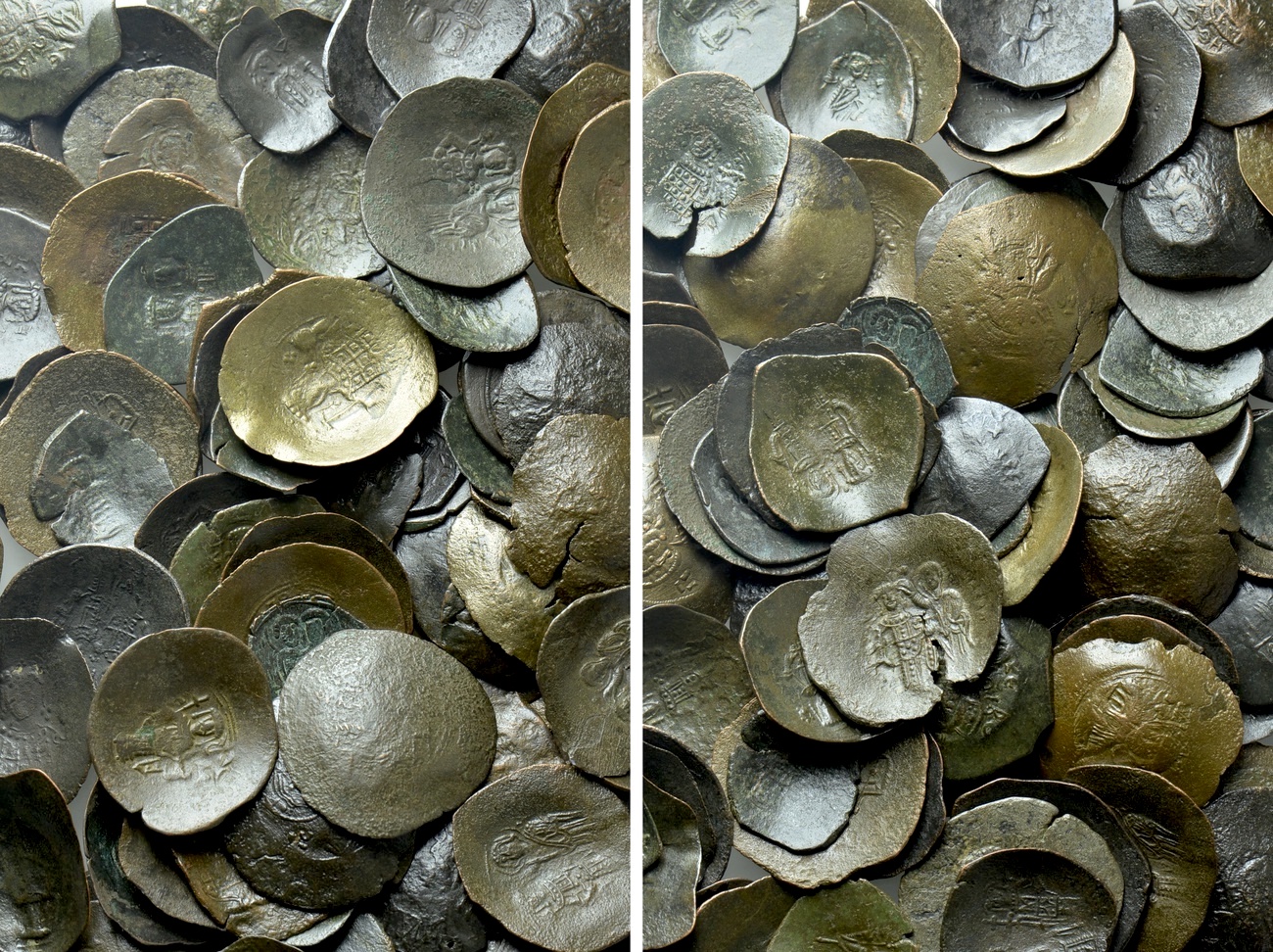
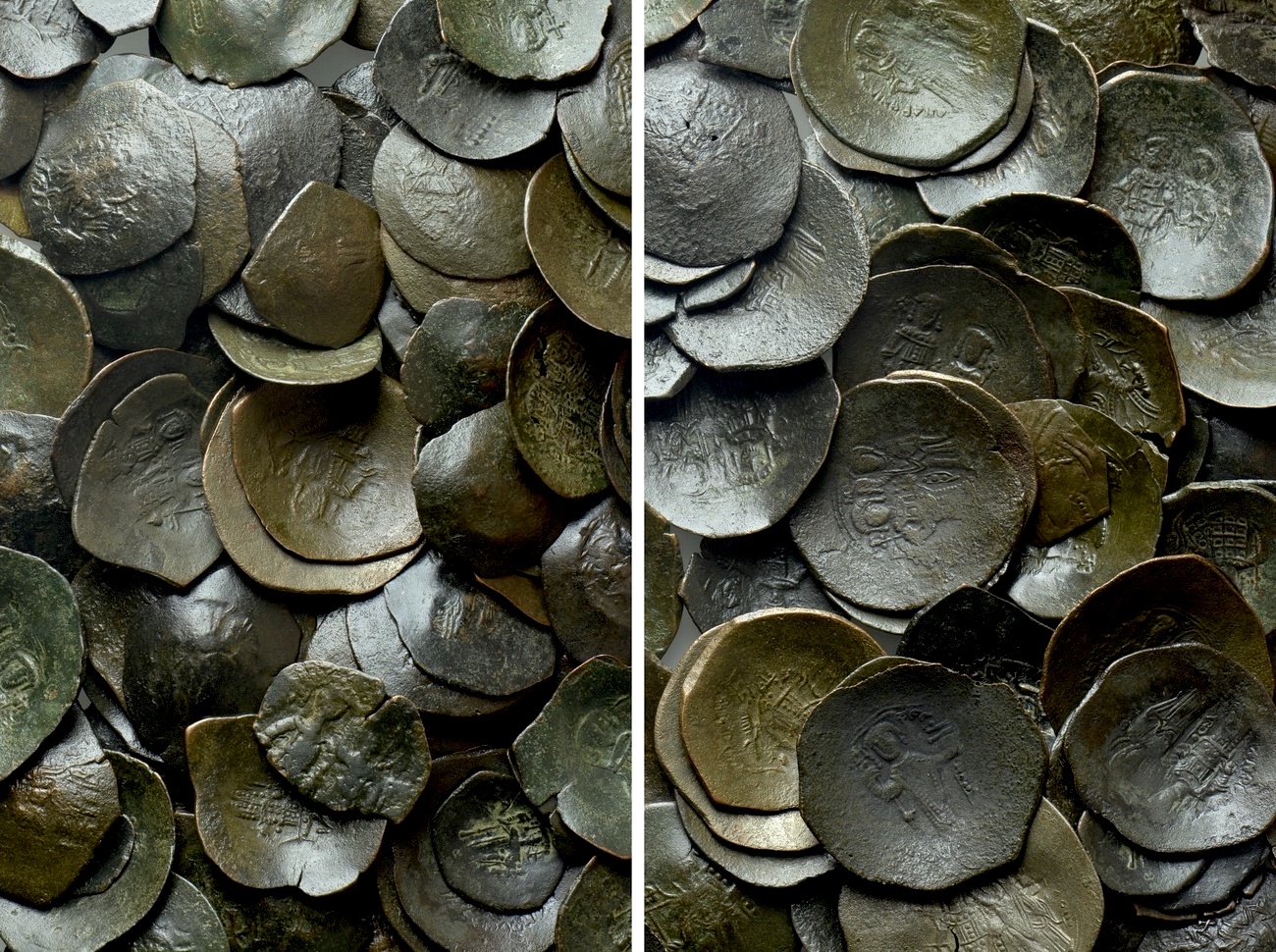
Impressive! Interesting to see that all coins are 'scoop' shaped. Was it custom to mint coins like that, and why? Ever since the emergence of coins, they used to be flat.
[EDIT:] Quant-Geek, thanks for the elaborate answer! Really very interesting!
An excellent question that is also quite complicated! Collecting Byzantine trachys is quite challenging (Byzantine coins, in general, is an acquired taste). The condition of most of these coins are poor with missing legends, ragged and split edges, multiple strikes, and due to the concave nature of the flan, missing features in the strike. Sometimes you end up with a very skinny Virgin Mary or a two-headed Christ. To add insult to injury, they are damn hard to photograph due to its awkward shape.
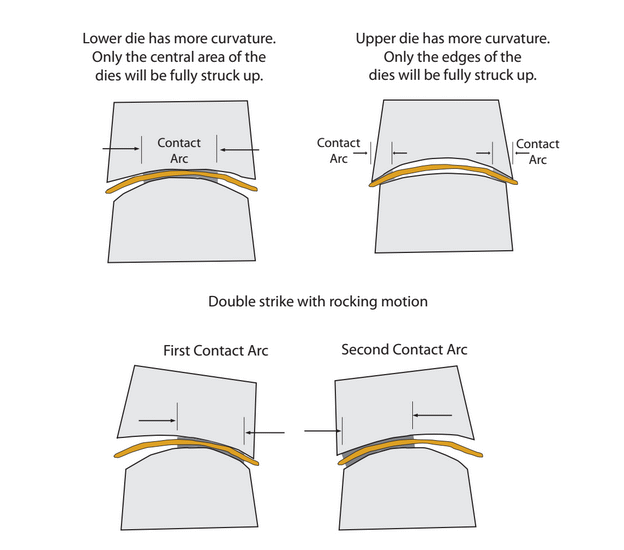
According to Simon Bendall, these coins were struck twice, once on the left and then on the right. His theory was that if the lower die had greater curvature than the upper die, then the middle of the coin would be fully struck with weak or blank sides. The opposite occurs if the upper die had greater curvature than the lower die. The edges would be fully struck and the center would be weak or blank.
This can be observed in the following trachy that has a very skinny Virgin. The rocking motion of the strike resulted in the obverse to be a bit constricted:
Obv: MP - ΘV; The Theotokos (Virgin Mary) standing facing on dais, holding bust of the infant Christ.
Rev: ANΔPONIKOC ΔECΠOTHC / IC - XC; Andronicus standing facing, holding labarum and globus cruciger, being crowned by Christ to right, holding Gospels
This particular coin resulted in a double-headed St. Michael due to an over-shifting in the middle:
Byzantine Empire: Michael VIII Palaeologos (1261-1282) Æ Trachy, Constantinople Mint (Sear 2268)
Obv: X/M to right; Half-length figure of St. Michael, beardless and nimbate, wearing divitision, collar-piece and loros; right hand holds trilobate scepter resting over shoulder; left hand holds globus
Rev: X/M to left; Full-length figure of emperor on left, and of St. Demetrius (?), beardless and nimbate; between them labarum on long shaft, that ends to three steps. Emperor wears stemma, divitision, collar-piece and jeweled loros of simplified type; right hand holds cruciform scepter. Saint wears tunic, breastplate and sagion
The question is why would anyone go through this much trouble to strike coins? There are several competing theories, but the most prominent one is that by creating a complex minting process, it deters counterfeiting. This method not only transcended throughout the Byzantine Empire, but also other empires around its outer perimeter:
Bulgaria, Second Empire: Mihail Asen III Šišman (1323–1330) Æ Trachy, Veliko Turnovo (Raduchev & Zhekov 1.12.1; Youroukova & Penchev 65; Dobrinić & Dimnik 8.2.1; Dochev 1790)
Obv: MXAHΛ IШANN; Mihail Šišman (to left) and Ivan Stefan (to right) standing facing, holding long cross between them
Rev: Šišman tamgha
Normans in Sicily: Roger II (1130-1154) AR Ducale, Palermo (Spahr 72; MEC 212; Biaggi 1770)
Obv: + IC • XC • RG • IN AE TRN (Jesus Christus regnat in aeternum); Bust of Christ facing, wearing nimbus cruciger, pallium and colobium, and raising right hand in benediction; in left hand, book of Gospels
Rev: King Roger and his son Roger, duke of Apulia, staff with cross at each end between them, beneath the king R RX SCLS (Rogerius Rex Siciliae), beneath the duke, R • D X • AP (Rogerius Dux Apuliae) and AN R X (Anno decimo del regno) between them
Quote: "Quant-Geek"An excellent question that is also quite complicated! Collecting Byzantine trachys is quite challenging (Byzantine coins, in general, is an acquired taste). The condition of most of these coins are poor with missing legends, ragged and split edges, multiple strikes, and due to the concave nature of the flan, missing features in the strike. Sometimes you end up with a very skinny Virgin Mary or a two-headed Christ. To add insult to injury, they are damn hard to photograph due to its awkward shape.
According to Simon Bendall, these coins were struck twice, once on the left and then on the right. His theory was that if the lower die had greater curvature than the upper die, then the middle of the coin would be fully struck with weak or blank sides. The opposite occurs if the upper die had greater curvature than the lower die. The edges would be fully struck and the center would be weak or blank.
This can be observed in the following trachy that has a very skinny Virgin. The rocking motion of the strike resulted in the obverse to be a bit constricted:
Byzantine Empire: Andronicus I Commenos (1183-1185) Æ Trachy, Constantinople (Sear 1985)
Obv: MP - ΘV; The Theotokos (Virgin Mary) standing facing on dais, holding bust of the infant Christ.
Rev: ANΔPONIKOC ΔECΠOTHC / IC - XC; Andronicus standing facing, holding labarum and globus cruciger, being crowned by Christ to right, holding Gospels
This particular coin resulted in a double-headed St. Michael due to an over-shifting in the middle:
Byzantine Empire: Michael VIII Palaeologos (1261-1282) Æ Trachy, Constantinople Mint (Sear 2268)
Obv: X/M to right; Half-length figure of St. Michael, beardless and nimbate, wearing divitision, collar-piece and loros; right hand holds trilobate scepter resting over shoulder; left hand holds globus
Rev: X/M to left; Full-length figure of emperor on left, and of St. Demetrius (?), beardless and nimbate; between them labarum on long shaft, that ends to three steps. Emperor wears stemma, divitision, collar-piece and jeweled loros of simplified type; right hand holds cruciform scepter. Saint wears tunic, breastplate and sagion
The question is why would anyone go through this much trouble to strike coins? There are several competing theories, but the most prominent one is that by creating a complex minting process, it deters counterfeiting. This method not only transcended throughout the Byzantine Empire, but also other empires around its outer perimeter:
Bulgaria, Second Empire: Mihail Asen III Šišman (1323–1330) Æ Trachy, Veliko Turnovo (Raduchev & Zhekov 1.12.1; Youroukova & Penchev 65; Dobrinić & Dimnik 8.2.1; Dochev 1790)
Obv: MXAHΛ IШANN; Mihail Šišman (to left) and Ivan Stefan (to right) standing facing, holding long cross between them
Rev: Šišman tamgha
Normans in Sicily: Roger II (1130-1154) AR Ducale, Palermo (Spahr 72; MEC 212; Biaggi 1770)
Obv: + IC • XC • RG • IN AE TRN (Jesus Christus regnat in aeternum); Bust of Christ facing, wearing nimbus cruciger, pallium and colobium, and raising right hand in benediction; in left hand, book of Gospels
Rev: King Roger and his son Roger, duke of Apulia, staff with cross at each end between them, beneath the king R RX SCLS (Rogerius Rex Siciliae), beneath the duke, R • D X • AP (Rogerius Dux Apuliae) and AN R X (Anno decimo del regno) between them
Lovely Shishman trachy! I prefer the cupreous issues from Bulgaria but I still have some trachys in my collection.
Quote: "krezga"Oh, that can be so much fun to identify that many ancient coins!
As long as you have proper books and research papers, otherwise it would be extremely difficult. There isn't that many public websites that goes into this amount of depth, including Wildwinds. Been meaning to create one for a loooong time, but I am currently using Zeno for this time period. I also collect Hungarian coins:
Hungary: Lajos (1342-1382) Denár (Huszár-542, Unger-429v)
Obv: + LODOVICI • R • VnGARIE, Two-part shield (Árpádian stripes and Angevin field of fleur-de-lis) with three lilies above and to sides.
Rev: S • LADIS—LAVS • R •, Standing nimbate king, facing, holding halberd and imperial orb, lily in right field.
Quote: "Quant-Geek"An excellent question that is also quite complicated! Collecting Byzantine trachys is quite challenging (Byzantine coins, in general, is an acquired taste). The condition of most of these coins are poor with missing legends, ragged and split edges, multiple strikes, and due to the concave nature of the flan, missing features in the strike. Sometimes you end up with a very skinny Virgin Mary or a two-headed Christ. To add insult to injury, they are damn hard to photograph due to its awkward shape.
According to Simon Bendall, these coins were struck twice, once on the left and then on the right. His theory was that if the lower die had greater curvature than the upper die, then the middle of the coin would be fully struck with weak or blank sides. The opposite occurs if the upper die had greater curvature than the lower die. The edges would be fully struck and the center would be weak or blank.
This can be observed in the following trachy that has a very skinny Virgin. The rocking motion of the strike resulted in the obverse to be a bit constricted:
Byzantine Empire: Andronicus I Commenos (1183-1185) Æ Trachy, Constantinople (Sear 1985)
Obv: MP - ΘV; The Theotokos (Virgin Mary) standing facing on dais, holding bust of the infant Christ.
Rev: ANΔPONIKOC ΔECΠOTHC / IC - XC; Andronicus standing facing, holding labarum and globus cruciger, being crowned by Christ to right, holding Gospels
This particular coin resulted in a double-headed St. Michael due to an over-shifting in the middle:
Byzantine Empire: Michael VIII Palaeologos (1261-1282) Æ Trachy, Constantinople Mint (Sear 2268)
Obv: X/M to right; Half-length figure of St. Michael, beardless and nimbate, wearing divitision, collar-piece and loros; right hand holds trilobate scepter resting over shoulder; left hand holds globus
Rev: X/M to left; Full-length figure of emperor on left, and of St. Demetrius (?), beardless and nimbate; between them labarum on long shaft, that ends to three steps. Emperor wears stemma, divitision, collar-piece and jeweled loros of simplified type; right hand holds cruciform scepter. Saint wears tunic, breastplate and sagion
The question is why would anyone go through this much trouble to strike coins? There are several competing theories, but the most prominent one is that by creating a complex minting process, it deters counterfeiting. This method not only transcended throughout the Byzantine Empire, but also other empires around its outer perimeter:
Bulgaria, Second Empire: Mihail Asen III Šišman (1323–1330) Æ Trachy, Veliko Turnovo (Raduchev & Zhekov 1.12.1; Youroukova & Penchev 65; Dobrinić & Dimnik 8.2.1; Dochev 1790)
Obv: MXAHΛ IШANN; Mihail Šišman (to left) and Ivan Stefan (to right) standing facing, holding long cross between them
Rev: Šišman tamgha
Normans in Sicily: Roger II (1130-1154) AR Ducale, Palermo (Spahr 72; MEC 212; Biaggi 1770)
Obv: + IC • XC • RG • IN AE TRN (Jesus Christus regnat in aeternum); Bust of Christ facing, wearing nimbus cruciger, pallium and colobium, and raising right hand in benediction; in left hand, book of Gospels
Rev: King Roger and his son Roger, duke of Apulia, staff with cross at each end between them, beneath the king R RX SCLS (Rogerius Rex Siciliae), beneath the duke, R • D X • AP (Rogerius Dux Apuliae) and AN R X (Anno decimo del regno) between them
Lovely Shishman trachy! I prefer the cupreous issues from Bulgaria but I still have some trachys in my collection.
Bulgaria is one of my main collecting themes. You can see a large collection of Bulgarian coins on my gallery:
I haven't had the chance to properly attribute them as it is quite difficult. You can either lump similar coins together (which I do not prefer), or do a proper attribution, but that takes time...
Quote: "Quant-Geek"About 250 Late Byzantine Coins, waiting to be identified!
Man I would have a lot of fun with these. I don't really collect Byzantine coins or know much about them but with a lot like this by the time I'd identify them all I would be hooked. Same thing happened with Romans, I got a few large lots and by the time I was done identifying them I decided to start collecting.
Enjoy!
Since I'm here I might as well post something. Got these two last month but haven't posted them, an As Traianus and a Sestertius of Faustina the Younger (Matri Magnae):
I collect and deal in ancient Roman coin. In case you're looking for affordable ancient coins or need any help with the coins you already have send me a message.
Got 3 new historical jetons/tokens/medals:
Jeton made to comemorate the coronation of King Louis XVI (atleast I have read this in one source)
Medal or token - 1635 - Cardinal Richelieu
Medal comemorating the 18th birthday and coronation of Queen Wilhelmina
Ahoj
Again auction- to supplement my collection German States, all the small coins, but the first one surprised me.
( The pictures are a bit dark I need to replace the magnifier-in fact the color of silver is light with patina)
1,
Free imperial city of Bremen, 1764, RDDB https://en.numista.com/catalogue/pieces134789.html
2,1 Kreuzer - Maximilian II. Emanuel, 1703 https://en.numista.com/catalogue/pieces130986.html
3,? not found / 1 Krauzer , Karl Albrecht 1726 , Bavaria
4,Free imperial city of Bremen,1 Groten, Brémy 1750
5,1 Archbishopric of Mainz, Kreuzer - Lothar Franz von Schönborn, 1721 https://en.numista.com/catalogue/pieces141532.html
6, Electorate of Bavaria, 2 Kreuzer - Maximilian I, 1624
7,Free city of Regensburg,1 Kreuzer,1644
8,Free city of Augsburg,2 Kreuzer, 1624
9, Kingdom of Prussia ,½ Silber Groschen - Friedrich Wilhelm IV
10+11, Bavaria-Landshut, 1 Pfennig - Heinrich IV. der Reiche Ötting ( one to be H and the other to L )
1393-1450 H + 1450-60 L- Ludvig IX -Bavaria-Landshut ( I don't know which is which)
a,
Got this nice token/medal that celebates the french "victory" at the battle of Seneffe. Both sides claimed to have won that battle and today it is seen as a draw. There is a similiar one on numista but the portrait and the engraver are different. ( https://en.numista.com/catalogue/pieces89908.html )
Also I got this bronze medal that was given to the prussian guard regiments after the death of King Friedrich Wilhelm III.
Managed to get this 1834 Guernsey 8 doubles for the opening bid price and really pleased with it in hand:
Beautiful condition for 185 years old and the edge is virtually pristine. What's more, it's the last 8 doubles type that I needed for my collection so really chuffed all round. I have my own idea but would be pleased to learn others' ideas on grade ...
Just because you can't see it ... doesn't mean it isn't there - Anon.
Starting in on wwi occupation period coins of Egypt -
a bit of trivia about the fractional coins, in order to get a complete set one needs
one half-millieme
two one-milliemes
three two-milliemes
four five-milliems and
five 10 milliemes
Jamais l'or n'a perdu la plus petite occasion de se montrer stupide. -Balzac
Ahoj and have a nice day.
I don't know what to say I'm in shock !
My wife brought this to me, from her colleague at work. Like free for me, she doesn't collect the coins.
I still don't know what to say, if I were young and handsome-so I suspect. But it's not me anymore.
I am happy about such a gift and I will send something nice to the lady. I still don't know what it all contains in a wooden box,
It is gold-plated 999 copper-They are Our Presidents, some gift edition with certificate and personal signature.
I haven't collected the banknotes so far, so I'm starting. and the coin is a blend but the Libyan is a pile yet I don't know.
Been to a coin fair today in São Paulo (with my grandfather), so lots of new things, like:
-Some old notes, including half dozen german notgelds;
-One Polish-Lithuanian and one Mughal silver;
-3 Portuguese ceitis;
-A few ancient Rome/Greece;
-One Abassid copper and 2 early islamic unsorted silvers;
-22 yet to identify medievals.
About these medieval (which I may ask for help about them over the next week), I got them with a seller that had a box of unsorted coins written "roman/medieval/arabs for R$ 10 each" ($ 2,5 - 2 €). 70% completely erased, but I found some interesting ones, mostly Papal States sec. XVI. None perfect, but most with something identifiable, like a partial shield or figure.
One of my favourites from my December additions so far, I thought quite fitting also after the UK‘s general election (let‘s not discuss politics here )
England, declaration of Parliament in 1642
If you like coins, medals and tokens with ship motives follow my new instagram account with regular updates @numisnautiker
From time to time I sell some coins on Ebay make sure to follow me @apuking on Ebay.
The krajczár sadly not in the best condition, but was a bargain and missing from my collection The other just a tourist token from the Czech Republic, nowdays I don’t really buy this tokens, but we spent a few days in Czech Republic, and this looked good, and I just wanted some memory from there.
Received some tokens and medals from the german monarchies this week:
Early WW1 medal showing the allied german and austro-hungarian emperors. Later the King of Bulgaria and the Ottoman Sultan will join them on the battlefield and on the medals:
Token from saxony made during the short reign of King Georg. Tokens, medals and coins bearing bis portrait are quite rare so Iam happy to fill a gap with this one:
Token from the Kingdom of Hannover made under the rule of King Georg V, celebrating the anniversary of the agricultural club:
I found 16 of these in a roll from a collection I bought. The photo is from a cell phone camera and does not do the coin any favors. 95% full red UNC. The white spec on the obverse is lint and not part of this coin.
Quote: "COINMAN1"
This coin, now added to the catalogue, has a golden Kookaburra
This golden Kookaburra, already in the catalogue, came with original box and golden Kookaburra badge.
The coin dealer did not know where this coin was from.
Belarus 20 Rubles 2010 KM#241 (Age of Majority)
Very nice, how expensive was the Belarussian one?
SpuDy,
Price of the Belarus coin was £17.50 less 10% discount, so appropriately £15.75. Thought that was really cheap. What do you think the correct selling price should have been?
Quote: "COINMAN1"SpuDy,
Price of the Belarus coin was £17.50 less 10% discount, so appropriately £15.75. Thought that was really cheap. What do you think the correct spelling price should have been?
$25-30)
My personal list of scammers from Numista: erniemix, yvain, CassTaylor
a few recent purchases
WW 1 era Egypt
some various Latin American pieces
modern french silver, bullion coin I suppose.
very pleased with this centime from the 1948 Republic
lastly, I have added the Monaco Honoré III 1735 1/2 pezzatta (1 sol de 18 deniers), I have had the 1734 1 pezzatta (3 sols) for some time.
Jamais l'or n'a perdu la plus petite occasion de se montrer stupide. -Balzac
me again -
more Egypt, one H and and one KN. the first KN in my collection
Paris minted coins of Greece and Krete. the tiny 1 Lepta is the star of the show
Morocco collection growing. Lightning bolt mintmark on 1 franc
and a few odds. the EU de Colombia dime is pretty far gone, but just think of the stories it could tell
Jamais l'or n'a perdu la plus petite occasion de se montrer stupide. -Balzac
Another coin, among others, that I picked up before the end of the decade...
Pamphylia, Aspendus: Anonymous (ca. 465-430 BCE) AR Stater (SNG France 3, 12)
Obv: Helmeted nude hoplite warrior advancing right, shield in left hand, spear forward in right; countermark on lower right
Rev: EΣ-TFFΔI, triskeles clockwise; lion crouching left below in background, ΠΦ below lion, all within incuse square
Quote: "Quant-Geek"Another coin, among others, that I picked up before the end of the decade...
Pamphylia, Aspendus: Anonymous (ca. 465-430 BCE) AR Stater (SNG France 3, 12)
Obv: Helmeted nude hoplite warrior advancing right, shield in left hand, spear forward in right; countermark on lower right
Rev: EΣ-TFFΔI, triskeles clockwise; lion crouching left below in background, ΠΦ below lion, all within incuse square
Really nice coin you have here!
Could I use your pictures to add it to the Numista catalogue?
Thanks,
Stavros
Referee for Ancient Greece, Norway and the Kingdom of Cyprus
I received some historical royal tokens/medals today:
Medal from belgium celebrating the nurse service of Queen Elisabeth during WW1.
Belgish medal from the same era showing the 2 sons of King Albert I.
British token celebrating the marriage of future King Edward VII and Alexandra of Danmark.
Quote: "Quant-Geek"Another coin, among others, that I picked up before the end of the decade...
Pamphylia, Aspendus: Anonymous (ca. 465-430 BCE) AR Stater (SNG France 3, 12)
Obv: Helmeted nude hoplite warrior advancing right, shield in left hand, spear forward in right; countermark on lower right
Rev: EΣ-TFFΔI, triskeles clockwise; lion crouching left below in background, ΠΦ below lion, all within incuse square
Really nice coin you have here!
Could I use your pictures to add it to the Numista catalogue?
Thanks,
Stavros
Quote And some Prussian and Polish-Lithuanian commonwealth coins yesterday while travelling in Lithuania:
Awesome coins, I especially love the coin struck under the rule of the first Prussian king. I see those coins quite rarely for sale and only own an damaged example of the same VI Gröscher coin I bought from Lithuania too.