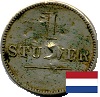
Mystery ancient Arabic bronze coin

7 posts
Hi, during the summer while vacationing in Israel, I spent a day in Petra (Jordan) and along with three other ancients, purchased this: I know that is from around 1200-1400 AD, and issued during the arabic/muslim rule:


Although the images may not be perfect, there seems to be a lion or some kind of animal on one side
Has anyone seen this before? Any information on it?

Thanks  (;0

Moved by ZacUK from Numismatic questions to Coin identifications and valuations
Numista referee for Canada and Estonia.
Hi eminem,

It is either a fake coin, which went thru the infamous Anatolian "ancient coin creation process", which is:
1) Grab a skilled goldsmith to make a die, then hammer and copy,
2) Put it in a concrete mixer for a day or two, to get the circulation hints,
3) Send the coin through the digestion system of a sheep 3-4 times, so it gets the ageing acids.
OR
You are lucky and this is a coin from about the 8th-9th century BC [earlier than yr estimation], where the imitation of greek letters and coinage is still a fashion (above pic)... see also Barbarians and Celts for Greek imitations!
 and the reserve already contains the early muslim Qufic script, of which there are hints reading: "Ma LimK", which means "King" [almost], but unfortunately, the name of the King is nonreadable, invisible.

In this case: to judge, it would be essential to view the edge of the coin with a microscope, and measure:
1) If it is a thick (e.g. even 2-3mms, or at least 0.8), than BINGO, you have chances to own an original :wiz: , provided that when you microscope the edge you see layers of metal, like you would see it in the Rocky Mountains for layers of rock (but of course smaller :) )
2) If it is thin and smooth, then it is a fake.

I hope for option one!
In that case you have a more expensive coin, than you think!

Let me know the results,
Imre
Thanks Imreh for replying,

It just so happens that I do have a dusty old microscope and after several minutes of trying to figure out how to see the edge of the coin, I was able to see it quite well.

Thickness:
The coin is about 1-1.3mm in most parts but the edge thins down in some parts.

Edge:
When I looked under the microscope what I saw looked like this:

It is not a clear straight line of metal but there are two clearly different colours.

Hope this helps in seeing whether its real or not, and thanks again!  :8D
Numista referee for Canada and Estonia.
Hi eminem,

An edge like that may indicate that it is an electro-type. This is a procedure to make genuine looking copies of coins for scientific or promotional reasons (like selling them to tourists 8~  ).
The referred site Calgary Coin is interesting to browse. It shows different methods to falsify (ancient) coins and what specific traces each of these methods leaves behind.

Arno
Quote: ArnoVHi eminem,

An edge like that may indicate that it is an electro-type. This is a procedure to make genuine looking copies of coins for scientific or promotional reasons (like selling them to tourists 8~  ).
The referred site Calgary Coin is interesting to browse. It shows different methods to falsify (ancient) coins and what specific traces each of these methods leaves behind.

Arno
I tend to agree :(
But don't give up! Still in order to judge you need to hold it in hand...
Thanks for the website, it's quite helpful. The edge of my coin does not look like the electrotyping edge on the website, so I will stay optimistic even though in cases like these a fake coin is the more likely option. I'm going to a big coin show in two weeks and I'll see if any of the ancient coin dealers have more insight.

thanks for your help guys  :P
Numista referee for Canada and Estonia.
Oh Yes, yes, ArnoV! Dank U!

Thanks for the website, very informative. I have been using this one for orientation: http://www.forumancientcoins.com/fakes/index.php

» Forum policy

Used time zone is UTC+2:00.
Current time is 05:46.